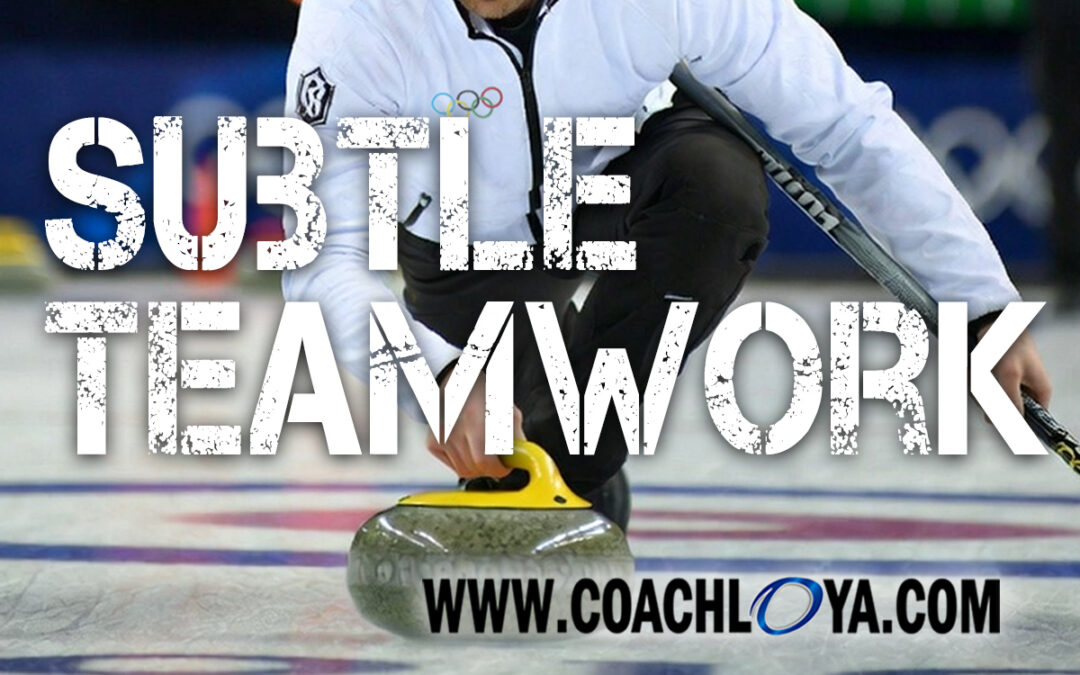
Have you been watching the Winter Olympics? I’ve become completely captivated by the sport of curling.
Last week, 54-year-old curler Rich Ruohonen made history by becoming the oldest American ever to compete in the Winter Olympics. A personal injury attorney from Brooklyn Park, Minnesota, Ruohonen has been spotted wearing a t-shirt around the Olympic village that reads: “I’m not the dad, and I’m not the coach.”
Those t-shirts have quickly become hot item at the Milano Cortina Olympics.
While Ruohonen’s story is worthy of its own “good teammate” tribute (he drives the team’s rented minivan, cooks teammates omelets before big games, grills steaks after big wins, and generously uses his personal income from his law practice to help cover team travel expenses not fully covered by Olympic stipends), my fondness for curling is rooted in something a bit deeper.
Curling is thought to be one of the world’s oldest team sports, with origins dating back to 16th-century Scotland.
If you’re not familiar with the sport, it is played on ice, where players slide heavy stones toward a target, while teammates sweep the ice in front of the stone to control its speed and direction, trying to finish closer to the center than the opposing team.
Points are awarded at the end of each round, called an “end,” with teams earning one point for each of its stones that is closer to the center than the opponent’s nearest stone.
Curling is a masterclass in subtle teamwork—unheralded collaborative nuances that advance shared goals—and good teammates excel at it. Here are ten examples of how:
1. Stay calm under pressure. Curling rewards steady nerves and emotional control. Teammates help regulate each other’s energy. Sometimes the situation calls for them to prompt enthusiasm, and other times, restraint.
2. Everyone has a role, and all roles matter. Throwers, sweepers, and the skip (i.e., the “captain” responsible for tactical decisions and throwing the final stone) contribute differently, but the shot only works if everyone does their job together.
3. Communication beats ego. Sweepers constantly talk, adjust, and defer to the skip. There’s no room for “I’ve got this” solo heroics. All for one and one for all.
4. Support in real time. Teammates actively help each other mid-play (sweeping harder or easing off) instead of waiting to critique afterward. They don’t have the luxury of debating strategy while the play is happening.
5. Trust the call. Once a decision is made, the team must fully commit—even if someone initially disagrees. In that moment, commitment to execution is more important than continued examination.
6. Know when to speak and when to listen. Appropriateness and timing of communication are crucial. Sometimes the best teammate is the loudest voice on the ice, sometimes it’s total focus and silence.
7. Adapt to changing conditions. Ice conditions change as the match progresses. Successful teams learn and modify their approach together rather than clinging to old assumptions. Rigidity prevents progress.
8. Adjust, don’t blame. When a stone goes off line, the response must be “what do we do now?” not “who messed up?” Blaming, shaming, and complaining detract from taking timely action.
9. Win and lose together. Success and mistakes are shared, not pinned on one person. Unlike many other team sports, curling’s scoring prevents players on the losing side from claiming individual statistical glory.
10. Celebrate small successes. A timely word of encouragement or recognition after a well-placed shot keeps morale high. Even minor acknowledgements can build trust, unity, and momentum across the team.
Every stone used at the Winter Olympics comes from Alisa Craig, a tiny, uninhabited island off the coast of Scotland. The granite quarried there is uniquely resistant to condensation and cracking, making it ideal for curling stones that glide smoothly and consistently.
Good teammates might not be resistant to condensation like granite, but they are resistant to cracking (under pressure), inflated egos, blame, rigidity, and all the other stressors that keep subtle teamwork from flowing smoothly and consistently.
As always…Good teammates care. Good teammates share. Good teammates listen. Go be a good teammate.