
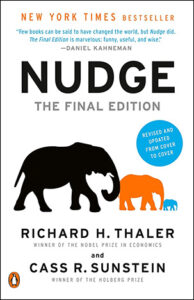
Of all the books I read last year, Nudge made me think most deeply about the ways leaders can help individuals become better teammates.
Written by Richard Thaler and Cass Sustein, the book explores how small, thoughtfully designed changes in how choices are presented can gently steer people toward better decisions without restricting their freedom to choose.
 For example, the authors describe how supermarket floor plans can be laid out to influence customers’ purchasing habits. They also explain how school food service directors can strategically display foods and arrange cafeterias to encourage students to make healthier choices.
Simply by arranging the cafeteria to place carrots at eye level instead of French fries, or desserts at the back of the line instead of the front, food service directors could increase students’ consumption of healthy foods and decrease their consumption of unhealthy ones.
These small, subtle nudges—hence the book’s title—can lead to surprisingly profound results.
Thaler and Cass refer to those responsible for organizing the context in which people make decisions as “choice architects.” In the examples above, supermarket managers and school food service directors serve as choice architects.
So do those who design ballots for voters to choose candidates, doctors who present treatment options to patients, and HR directors who offer employees health care enrollment options.
Choice architects do not force decisions through direct control. They use thoughtful positioning, framing, and phrasing to indirectly influence others’ decisions.
Getting leaders to understand that team members cannot be forced to be good teammates isn’t always easy. I remind them that you can enforce compliance, but you can’t enforce commitment. After all, being a good teammate—someone committed to the greater interests of the team—is ultimately a matter of choice.
However, there are subtle things leaders can do to nudge someone toward making that choice. Here are three:
1. Incorporate the term “good teammate move” into your team’s jargon.
Good teammate moves are selfless actions that move the team in the right direction. Psychologically, using this specific term can inspire selfless behavior in a manner that phrases like “good deeds” or “random acts of kindness” cannot, because it taps into team members’ natural competitive instincts and innate human desire to achieve and acquire.
2. Flood your environment with incessant reminders.
The reminder to be a good teammate should never stray far from the mind of any team member. Signs, posters, screensavers, email signatures, lapel pins, rubber wristbands, T-shirts, or anything else that promotes being a good teammate can help reinforce that expectation. They may not define your team culture, but they do strengthen it by serving as constant cues of what matters most on your team.
3. Recognize and reward unselfishness.
Let no selfless act go unrecognized. Publicly praise collaboration that results from sacrificing individual “wants” for team “needs.” And remember, words often make the best rewards (e.g., nice job, way to go, thank you).
Leaders cannot manufacture commitment, but they can shape the environment in which commitment becomes the natural choice. Forcing team members to be good teammates will eventually backfire because they won’t feel like they ever had a choice. A little nudge, however, can be the better approach.
By educating team members about what it means to be a good teammate, showing them the benefits of it, and subtly nudging them in that direction, leaders act as choice architects—designing cultures where being a good teammate becomes the natural choice.
As always…Good teammates care. Good teammates share. Good teammates listen. Go be a good teammate.