
Sharing a Christmas story right after Easter might seem oddly timed, but a recent airport encounter was too good not to share.
While waiting to board my flight home to Florida, I had the privilege of meeting someone who embodied several of my favorite “good teammate” traits.
The seating area at my gate was predictably crowded, since it was a full flight and departure time was approaching. I spotted a pair of empty seats and asked the woman sitting nearby whether anyone was using them. She smiled and said her husband was in one, but I was welcome to sit in the other.
A few moments later, her husband, a jolly, older man with an eerily familiar presence, returned and plopped down between us. He immediately pointed to the logo on my quarter-zip and said, “Be a good teammate. Ooohhh, I like that.”
In that instant, I knew I was meant to sit in that exact seat.
Few things bring me more joy than meeting interesting people who share my love for caring, kindness, and genuine unselfishness—qualities I quickly discovered this man valued deeply.
He introduced himself, somewhat curiously, as “Santa Bob,” stating that he was in the process of “de-Santatizing.” At first, I found the introduction a bit strange. But as he went on to say he was a retired high school teacher and coach who now “works” as a professional Santa Claus, I realized what a brilliant description it actually was.
Santa Bob (*pictured above) informed me that he was a proud graduate of the C.W. Howard Santa School. For almost 90 years, the northern Michigan–based school has been training Santa’s helpers. Its namesake was the featured Santa in Macy’s Thanksgiving Day Parade from 1948–1965. He established the school in response to “his displeasure with seeing other Santas in frayed suits, cheap beards, and shockingly inadequate knowledge of reindeer.”
Under the current direction of Tom and Holly Valent, former C.W. Howard students themselves, the school trains about 300 joyful students each year.
Santa Bob shared stories about some of his favorite interactions with children. During a typical peak-season shift, he might have as many as 700 kids sit on his lap, and over time he has collected some real gems.
He told me about the time a boy asked him for a live frog, as well as meaningful interactions with children with special needs. He was especially proud of his ability to use sign language to communicate with deaf children.
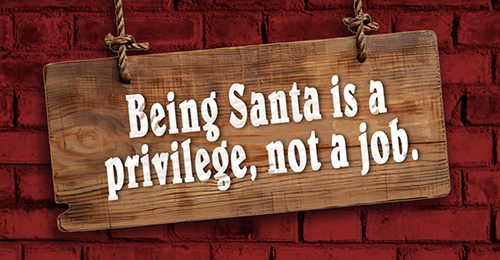
Of all the things he said to me, two stood out above the rest:
-
- Santa must embody the behaviors he expects from children.
- Being Santa is a privilege, not a job.
Both of these also apply to being a good teammate. Good teammates must always embody the behaviors they expect from the other members of their teams. Just because you’re having a bad day doesn’t excuse you to be a bad teammate any more than having a bad day would excuse one of Santa’s helpers to be a bad Santa.
Likewise, being a good teammate is a privilege, not a job. You set yourself—and your team—up for failure when you start thinking of the responsibilities attached to being a good teammate as burdens.
Good teammates get to encourage struggling teammates, get to hold wayward teammates accountable, and they get to be relied on to be perpetually enthusiastic, the same way that Santa gets to hear the same requests over and over, welcome crying children onto his lap with warmth, and stay joyful through even the busiest, most exhausting days.
Santa Bob had an earlier boarding group than I did. He rose from his seat and headed toward the gate, then stopped and turned back. Grinning, he bellowed, “Ho, ho, ho! Safe travels, Lance!”
As he disappeared down the jetway, I thought more about his earlier use of the term “de-Santatizing.” What a clever play on words!
It occurred to me that Santa Bob’s beard had been trimmed down to little more than white stubble. He was wearing comfortable, casual clothes, and he and “Mrs. Claus” were on their way to a sunny, warmer destination for some much-deserved rest and recuperation.
Being Santa can be exhausting, just like being a good teammate. To be the best at either requires a cleansing of sorts. You must occasionally step back, recharge your batteries, and revisit why you do what you do. In that sense, the concept of de-Santatizing is a good teammate move, rooted in self-care.
Good teammates—and good Santas—take care of themselves so they can better care for those who depend on them.
As always…Good teammates care. Good teammates share. Good teammates listen. Go be a good teammate.