In the past few weeks, several unsettling stories about wayward youth sports coaches and parents have made their way into the national headlines. As an advocate for good sportsmanship, seeing these types of stories always breaks my heart.
I was at a game over the weekend where a parent was constantly yelling at the officials, players, and coaches from the bleachers. He was loud, obnoxious, and downright annoying. And if that wasn’t enough, most of what he was yelling left me scratching my head.
At one point, he yelled for no apparent reason, “There’s no ‘I’ in team, coach.”
His assertion seemed bizarrely random. I heard an annoyed fan sitting nearby mutter under his breath, “No, but there is one in the a-hole.”
That response prompted several other fans to chuckle.
My friend, who was sitting next to me, leaned over and said, “I don’t get it. What does he mean by ‘in the a-hole?’” I explained the expression by pulling up an image on my phone.
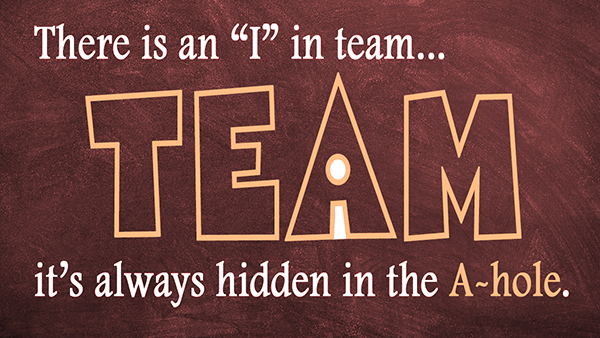
Though arguably a bit crude, the fan’s response to the obnoxious parent wasn’t without merit.
I thought about the situation for the rest of the game, eventually deciding both men were in the wrong. Instead of focusing on the “I’s,” they should’ve been considering the “eyes” that were upon them—the impressionable kids.
Our example speaks louder than our words. Good teammates understand this.
Kids learn how to behave by watching the adults around them. They notice how we respond when things don’t go our way, how we treat people with whom we disagree, and how we handle frustration. Our example quietly teaches them what is acceptable.
The same is true on every team.
Whether you realize it or not, your teammates are watching you. They see how hard you work when no one is checking. They see whether you blame others when you make a mistake. They see how you talk about teammates who aren’t around. And they see whether the standards you preach match the standards you practice.
Being a good teammate means never losing sight of those eyes. Your actions don’t exist in isolation. They influence the people around you, sometimes giving others permission to follow your example.
Complaining makes complaining easier for the next person. Cutting corners makes cutting corners more acceptable. Disrespect has a way of multiplying.
Fortunately, so do the good things. Hustle inspires hustle. Kindness encourages kindness. Owning mistakes makes it safer for others to own theirs. When one person consistently models the right behaviors, others are more likely to follow their example.
Anytime I see a parent, player, or coach acting inappropriately at a game, I am reminded of the poem “His Example” by Edgar Albert Guest:
There are little eyes upon you, and they’re watching night and day;
There are little ears that quickly take in every word you say;
There are little hands all eager to do everything you do,
And a little boy that’s dreaming of the day he’ll be like you.
You’re the little fellow’s idol, you’re the wisest of the wise;
In his little mind about you no suspicions ever rise;
He believes in you devoutly, holds that all you say and do
He will say and do in your way when he’s grown up just like you.
Oh, it sometimes makes me shudder when I hear my boy repeat
Some careless phrase I’ve uttered in the language of the street;
And it sets my heart to grieving when some little fault I see
And I know beyond all doubting that he picked it up from me.
There’s a wide-eyed little fellow who believes you’re always right,
And his ears are always open and he watches day and night;
You are setting an example every day in all you do
For the little boy who’s waiting to grow up to be like you.
That poem was published more than 100 years ago, yet its message still rings true today. There may not be an “I” in team, but there are always “eyes” on teammates. Be mindful of what your behavior is teaching them.
As always…Good teammates care. Good teammates share. Good teammates listen. Go be a good teammate.